Modern society depends heavily on digital technology. People use smartphones, computers, online banking, social media, cloud platforms, digital payment systems, healthcare applications, and connected devices every day. Businesses and governments also rely on digital infrastructure to store information and deliver important services.
As technology becomes more deeply connected to everyday life, protecting digital systems becomes increasingly important. This is where cybersecurity plays a major role. Cybersecurity involves the technologies, practices, and processes used to protect computers, networks, applications, devices, and data from unauthorized access, attacks, and other digital threats.
For readers exploring the cyber field, understanding cybersecurity is an important starting point. New Info Technology USA provides technology-focused information to help readers understand topics such as cybersecurity, artificial intelligence, software, and other technologies shaping the digital world.
What Is Cybersecurity?
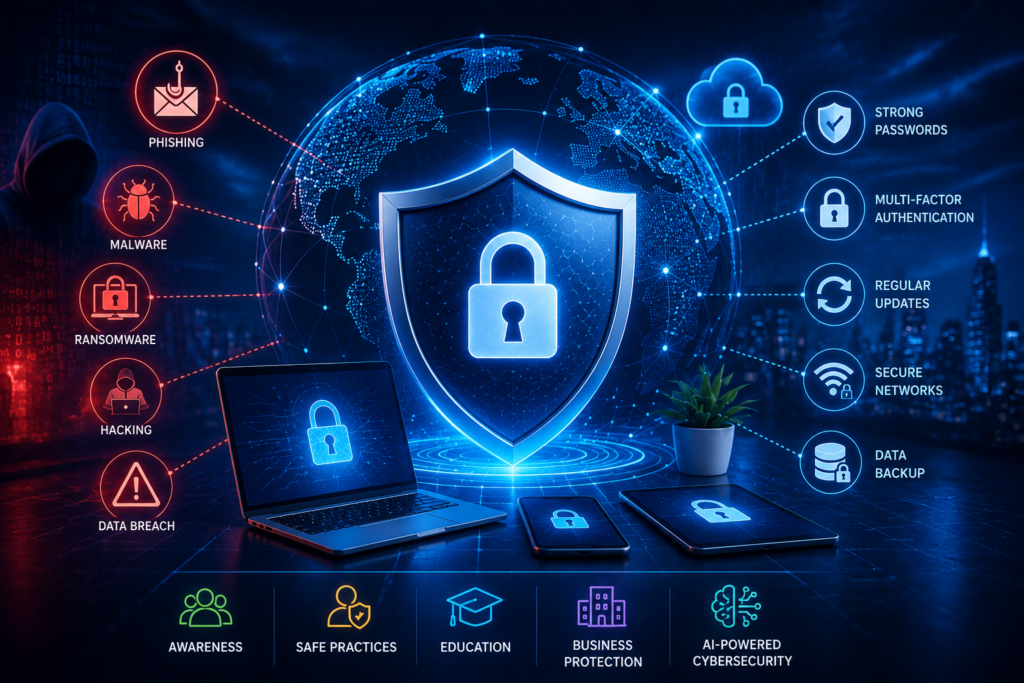
Cybersecurity refers to the protection of digital systems and information against threats. These threats can include malware, phishing, ransomware, password attacks, data breaches, social engineering, and unauthorized access.
Cybersecurity is not limited to large organizations. Individuals, schools, businesses, hospitals, financial institutions, and government organizations all need protection because they handle digital information and depend on connected technologies.
Effective cybersecurity can involve several areas, including:
- Network security
- Application security
- Cloud security
- Data protection
- Identity and access management
- Endpoint security
- Security monitoring
- Incident response
- Security awareness
These areas work together to reduce risks and help organizations respond when security incidents occur.
Why Is Cybersecurity Important for Modern-Day Society?
1. It Protects Personal Information
People share significant amounts of information online. Names, addresses, account credentials, financial information, photographs, and other personal details can be stored on digital platforms. If this information is exposed through a security breach, criminals may attempt to use it for fraud, identity theft, or other harmful activities.
Cybersecurity measures such as encryption, multi-factor authentication, secure passwords, and access controls can help reduce the risk of unauthorized access.
2. It Helps Protect Financial Transactions
Digital payments and online banking have become common parts of everyday life. People can transfer money, pay bills, shop online, and manage financial accounts without visiting a physical location. However, financial accounts are attractive targets for cybercriminals. Phishing, stolen credentials, malware, and fraudulent websites can be used to target users.
Cybersecurity helps financial organizations and payment platforms protect transactions and detect suspicious activity.
3. It Supports Healthcare Security
Healthcare organizations manage sensitive information, including medical records, patient information, and insurance details. Hospitals also increasingly depend on connected systems and digital devices. A cyberattack against healthcare infrastructure can potentially disrupt important operations and expose sensitive information.
Strong security controls, regular monitoring, employee awareness, and appropriate access management are therefore important components of modern healthcare technology.
4. It Protects Businesses
Businesses of all sizes rely on technology for communication, sales, accounting, customer management, storage, and operations. A successful cyberattack can interrupt business activities and potentially result in data loss, financial costs, or damage to customer trust.
Cybersecurity helps organizations identify vulnerabilities, protect important systems, and establish processes for responding to incidents.
The Growing Importance of the Cyber Field
The expansion of cloud computing, artificial intelligence, Internet of Things devices, mobile applications, and remote work has created a larger digital environment.
As this environment grows, the cyber field continues to cover a wide range of specialized areas. Cybersecurity professionals may work in security operations, penetration testing, vulnerability management, cloud security, application security, digital forensics, incident response, or security analysis.
The field also requires continuous learning because cyber threats and technologies continue to change.
What Is a Cybersecurity Alert?
A cybersecurity alert is a warning about a potential or confirmed digital security threat. Alerts may be generated by security software, network monitoring systems, government organizations, cybersecurity teams, or technology platforms.
For example, an alert might indicate:
- A suspicious login attempt
- Malware detected on a device
- Unusual network activity
- Multiple failed password attempts
- A potentially malicious email
- Unauthorized access to an account
- A vulnerability requiring attention
Cybersecurity alerts can help individuals and organizations recognize potential problems before they become more serious.
However, not every alert automatically means that a successful attack has occurred. Security teams generally investigate alerts to determine whether they represent genuine threats or false positives.
Cybersecurity and Connected Devices
Modern society contains billions of connected devices. Smartphones, smart televisions, security cameras, wearable devices, industrial equipment, and other Internet-connected technologies can communicate and exchange information.
While connected technology provides convenience, poorly secured devices can create additional security risks. Using strong authentication, keeping software updated, changing default passwords, and selecting trustworthy devices can help improve security.
The Role of Cybersecurity Awareness
Technology alone cannot eliminate every cybersecurity risk. Human behavior also plays an important role. Users can encounter phishing messages, suspicious links, fake websites, fraudulent downloads, and social engineering attempts. Even a well-protected organization can face risks if employees or users unknowingly provide sensitive information to attackers.
Cybersecurity awareness helps people recognize suspicious activity and make safer decisions.
Simple practices include:
- Using unique and strong passwords
- Enabling multi-factor authentication
- Keeping operating systems and applications updated
- Avoiding suspicious links and attachments
- Checking website addresses before entering sensitive information
- Backing up important data
- Responding carefully to unexpected security alerts
Cybersecurity in an AI-Driven World
Artificial intelligence is increasingly being used in cybersecurity. AI-based systems can help analyze large amounts of data, identify unusual patterns, detect potential threats, and support security monitoring.
At the same time, cybercriminals can also use advanced technologies to create more sophisticated attacks. This makes cybersecurity an evolving area where organizations need to continually review their security practices.
The combination of AI and cybersecurity is becoming an important area within the broader cyber field.
Why Cybersecurity Will Remain Important
Digital technology is unlikely to become less important in modern society. Instead, more activities are moving online, while organizations continue adopting cloud platforms, connected devices, automation, and artificial intelligence.
This means cybersecurity will remain an important part of digital development.
Organizations need to protect their infrastructure, while individuals need to understand basic digital security practices. Governments and technology providers also have roles in establishing secure systems and responding to emerging threats.
Conclusion
Cybersecurity is important for modern-day society because digital technology has become part of everyday communication, business, healthcare, finance, education, and public services.
From protecting personal information to securing business networks and responding to a cybersecurity alert, cybersecurity helps reduce the risks associated with an increasingly connected world.
For anyone interested in the cyber field, learning the fundamentals of cybersecurity provides a useful foundation for understanding how modern digital systems are protected. As technology continues to evolve, cybersecurity awareness and responsible digital practices will remain essential.
New Info Technology USA shares informational content about cybersecurity, artificial intelligence, software, digital technologies, and other developments shaping the modern technology landscape.
Frequently Asked Questions
What is the importance of cybersecurity in modern society?
Cybersecurity helps protect digital information, devices, networks, applications, and online services from unauthorized access and cyber threats.
What does the cyber field include?
The cyber field includes areas such as network security, application security, cloud security, penetration testing, vulnerability management, incident response, digital forensics, and security operations.
What is a cybersecurity alert?
A cybersecurity alert is a warning about suspicious or potentially harmful activity detected by a security system, monitoring tool, organization, or cybersecurity professional.
Why is cybersecurity awareness important?
Cybersecurity awareness helps people recognize threats such as phishing, malicious links, suspicious attachments, and fraudulent websites so they can make safer decisions online.
Can artificial intelligence help with cybersecurity?
Yes. AI can assist with tasks such as analyzing security data, identifying unusual patterns, detecting potential threats, and supporting security monitoring. However, AI does not eliminate the need for broader cybersecurity controls and human oversight.