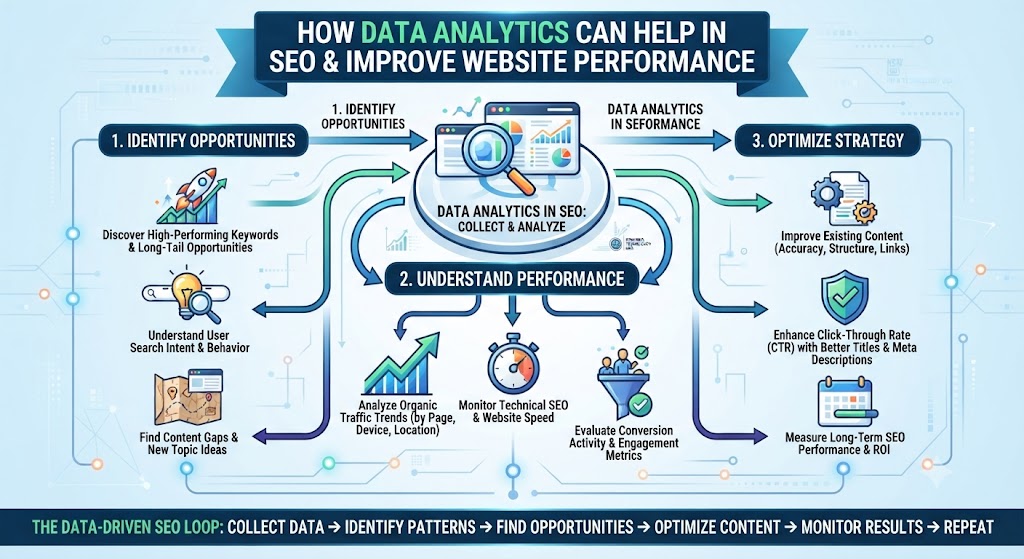
Search engine optimization (SEO) is more than improving keyword rankings or publishing new blog posts. It involves understanding how people discover a website, what they do after visiting it, and whether the content answers their questions. Without reliable measurement, it can be difficult to identify which SEO activities are working and which need improvement.
This is where data analytics becomes valuable. By collecting and analyzing information about organic traffic, search impressions, clicks, user engagement, and conversions, website owners can make more informed decisions about their SEO strategies.
As digital competition grows, new marketing technology is changing how marketers collect and interpret performance data. Modern analytics platforms, automation tools, and AI-assisted reporting can help identify trends that might otherwise go unnoticed. Understanding these capabilities also explains the growing importance of internet marketing technologies and data analytics in modern SEO.
For informational websites such as New Info Technology USA, measuring SEO success helps content creators understand which articles attract readers, which topics deserve further coverage, and how to build a more useful experience for visitors.
What Is SEO Data Analytics?
SEO data analytics is the process of collecting, analyzing, and interpreting information related to a website’s visibility in search engines and its organic search performance.
It helps website owners answer important questions:
- Which search queries bring visitors to a website?
- Which pages receive the most organic clicks?
- Are important keywords gaining or losing visibility?
- Do visitors engage with the content they find?
- Which pages contribute to meaningful business or content goals?
- What should be improved to achieve better search performance?
For example, a technology blog might publish an article about artificial intelligence. Google Search Console could show that the page receives impressions for several related searches but earns relatively few clicks. Analytics data might then help the publisher understand whether visitors who do click are engaging with the article.
Together, these insights help the publisher identify opportunities to improve the title, clarify the introduction, expand useful sections, or link to related articles. The goal is not simply to collect more data. It is to turn relevant information into practical decisions.
Why Is Data Analytics Important for SEO?
SEO results are influenced by many factors, including content relevance, competition, technical accessibility, search intent, and changes in search behavior. Data analytics helps separate assumptions from observable performance.
1. Understand Organic Traffic Trends
Organic traffic refers to visits that arrive through unpaid search engine results. Monitoring this traffic helps reveal whether a website is attracting more visitors from search over time.
For example, if a website experiences a decline in organic sessions, marketers can investigate whether the change affects the entire website or only a few pages. Possible explanations include seasonal demand, changing search interest, technical issues, increased competition, or changes in search engine results. Comparing equivalent periods and checking relevant search queries can help narrow down the cause.
2. Identify High-Performing Content
Not every article attracts the same level of search visibility. Some pages may generate consistent clicks, while others receive impressions without attracting many visitors. Analyzing page-level performance helps content creators identify successful topics and discover related subjects that deserve further exploration.
A technology blog might find that articles about cybersecurity basics attract more organic traffic than general technology news. That insight could support a content plan covering cybersecurity awareness, network protection, ethical hacking fundamentals, and related beginner questions. However, content decisions should consider relevance, quality, and reader needs—not traffic alone.
3. Discover Keyword Opportunities
Keyword analytics helps marketers understand how people search for information and how a website performs for those queries. Google Search Console provides query-level information such as clicks, impressions, click-through rate (CTR), and average position. Suppose an article receives many impressions for a specific question but relatively few clicks.
The page may be a candidate for reviewing the title, description, or alignment with search intent. These changes should be tested thoughtfully because low CTR can have several causes, including the type of search results displayed. Keyword research tools can complement this data by identifying related queries and estimating search demand.
4. Measure Progress Against Clear Goals
SEO success should be measured according to the purpose of the website. An online store may focus on purchases, while a technology blog may prioritize relevant readership, newsletter subscriptions, returning visitors, or engagement with related articles. Defining goals before reviewing analytics helps ensure that performance reports measure meaningful outcomes rather than presenting numbers without context.
Key SEO Metrics You Should Measure
A useful SEO report combines search visibility, website traffic, engagement, and outcomes. No single metric provides a complete picture of success.
Organic Clicks and Sessions
Clicks and sessions measure different things.
- Organic clicks: The number of times users click a website’s unpaid search result, as reported by a search performance tool.
- Organic sessions: Website sessions attributed to organic search in an analytics platform.
The numbers may differ because the platforms use different measurement methods, attribution rules, and definitions. Tracking both helps explain how search visibility translates into website visits.
Impressions
Impressions indicate how often a website’s search result was shown under the reporting tool’s measurement rules. Increasing impressions may suggest that a page is appearing for more queries or gaining visibility. However, impressions do not automatically mean that a page is ranking highly or attracting relevant visitors.
Click-Through Rate
Click-through rate, or CTR, measures the proportion of impressions that result in clicks.
Formula:
CTR = (Clicks ÷ Impressions) × 100
For example, if a page receives 1,000 impressions and 50 clicks:
CTR = (50 ÷ 1,000) × 100 = 5%
A CTR of 5% means that 5% of the recorded impressions resulted in clicks. Whether that is strong performance depends on the query, position, search features, device, and other circumstances.
Average Search Position
Google Search Console reports average position based on the positions of a site’s results across relevant impressions. This metric can help identify changes in search visibility, but it is an average rather than a fixed ranking for every user or search. Use it alongside clicks, impressions, and query-level information instead of treating it as a complete SEO score.
Engagement and Conversions
Website analytics can help you understand what visitors do after arriving on a page.
Depending on the website and tracking setup, useful measurements may include:
- Engaged sessions
- Average engagement time
- Newsletter sign-ups
- Relevant internal-link clicks
- Downloads or other meaningful interactions
- Purchases, enquiries, or completed goals
For an informational blog, reading time and engagement can offer useful context, but they should not be treated as direct proof of search engine ranking improvements.
How to Measure SEO Success Using Data Analytics: Step by Step
A consistent measurement process makes SEO analysis easier to repeat and more useful over time.
Step 1: Establish Your SEO Goals
Begin by deciding what success means for your website. For a technology blog, suitable goals might include increasing relevant organic clicks, improving visibility for targeted topics, attracting readers to important articles, and increasing newsletter subscriptions. Choose a manageable number of measurable goals rather than tracking every available metric.
Step 2: Set Up Google Search Console
Google Search Console helps website owners understand how their pages appear in Google Search.
Its Performance report provides information about clicks, impressions, CTR, average position, queries, and pages.
To evaluate a specific article:
- Open Google Search Console and select your website property.
- Open the Performance report for Search results.
- Choose an appropriate date range.
- Review clicks, impressions, CTR, and average position.
- Select the Pages tab and find the article.
- Review the Queries tab to understand which searches are associated with that page.
Compare equivalent periods when possible. If traffic falls, investigate individual queries and pages before making broad changes across the website.
Step 3: Use Google Analytics 4
Google Analytics 4 (GA4) helps explain what happens after people visit your website. You can use it to examine traffic acquisition, engagement, landing-page performance, and configured key events. For example, a technology blog may receive organic visits to an article about cloud computing. GA4 can help reveal whether visitors explore related articles or return to the site later, provided the relevant events and reporting are configured correctly. Make sure your analytics setup respects applicable privacy requirements and consent choices.
Step 4: Connect Search Performance With On-Site Behavior
Search Console and GA4 answer different questions. Search Console focuses on search performance, while GA4 focuses on activity measured on the website. Reviewing both can provide a more complete picture. Consider an article with increasing search clicks but declining engagement time. The increase in traffic may be positive, but the engagement pattern could indicate that visitors are not finding the information they expected—or it could reflect changes in the mix of visitors and measurement. Review the article’s introduction, structure, depth, accuracy, and alignment with search intent before deciding what to change.
Step 5: Segment Your Data
Website-wide averages can hide important differences. Break the data down into useful categories, such as:
- Landing page: Which articles attract organic visits?
- Query: Which searches generate impressions and clicks?
- Device: Does performance differ between mobile and desktop?
- Country or region: Where is relevant search traffic coming from?
- Topic category: Which subject areas attract the right audience?
- Time period: Are changes temporary, seasonal, or sustained?
Segmentation makes it easier to identify specific opportunities rather than making decisions based on a single overall number.
Step 6: Turn Insights Into Action
Data becomes useful when it leads to a clear next step.
For example:
| Observation | Possible action |
|---|---|
| High impressions but low CTR | Review search intent, title relevance, and search-result presentation |
| Declining clicks for a key article | Investigate query trends, competing pages, technical issues, and seasonality |
| Strong traffic to an older article | Verify facts, update outdated information, and add relevant internal links |
| Visitors struggle to find related content | Improve navigation and contextual internal linking |
| Important pages are not appearing in search | Check indexing, crawlability, canonical tags, and content relevance |
These actions are starting points for investigation, not guaranteed solutions. Confirm the likely cause before changing a page.
Step 7: Track Changes Over Time
SEO improvements may take time to become visible. Record important changes, such as title updates, content revisions, technical fixes, or new internal links. Then monitor the relevant metrics over an appropriate period. Avoid attributing every performance change to the most recent edit. Search demand, competitors, algorithm changes, and seasonal trends can also affect results.
How New Marketing Technology Is Improving SEO Analytics
New marketing technology is expanding the ways teams collect data, automate reporting, and discover opportunities.
AI-Assisted Analysis
AI-powered tools can summarize large datasets, group similar search queries, identify unusual performance changes, and suggest questions for further investigation. For example, a marketer could group hundreds of queries into themes such as machine learning, cybersecurity, cloud computing, and software development. These groups can help organize a technology blog’s content strategy. However, AI-generated findings should be checked against the original data. Tools can misinterpret trends, overlook context, or suggest relationships that do not establish causation.
Automated Reporting
Reporting tools can combine information from multiple sources and present it in dashboards. An SEO dashboard might show weekly organic clicks, top-performing landing pages, CTR changes, and conversions. Automation reduces repetitive reporting work and makes it easier to identify changes requiring attention. Reports should clearly define their metrics, date ranges, and data sources so that comparisons remain consistent.
Search Intent and Content Analysis
Modern SEO tools can help categorize queries according to informational, navigational, commercial, or transactional intent. For an informational technology website, this can help distinguish readers seeking basic explanations from those comparing software or researching technical solutions. Content analysis can then identify missing explanations, outdated information, and relevant questions that existing articles do not answer.
Integrated Internet Marketing Technologies
Internet marketing technologies include analytics platforms, search performance tools, content management systems, advertising platforms, customer relationship management software, and marketing automation systems. When configured appropriately, these technologies help teams understand how different channels contribute to audience discovery and engagement.
For example, analytics might show that readers first discover a cybersecurity article through organic search and later return through a newsletter. Understanding these journeys can support better content distribution and audience planning.
Common SEO Analytics Mistakes to Avoid
Even accurate data can lead to poor decisions if it is interpreted incorrectly.
- Focusing only on rankings: Rankings matter, but clicks, relevant traffic, engagement, and meaningful outcomes also deserve attention.
- Comparing unequal periods: Comparing a holiday period with a normal month may produce misleading conclusions. Use equivalent time ranges where possible.
- Treating correlation as causation: A traffic increase after publishing an article does not prove that the article caused the entire increase.
- Ignoring technical problems: Indexing errors, broken links, slow page experiences, and incorrect tracking can affect performance or make reports unreliable.
- Making too many changes at once: If titles, content, internal links, and technical settings all change together, it becomes harder to understand which changes contributed to the result.
- Overvaluing vanity metrics: Large impression counts are not enough if the website attracts the wrong audience or fails to meet readers’ needs. A disciplined measurement process helps marketers make better decisions without overreacting to short-term fluctuations.
Conclusion
Measuring SEO success using data analytics means looking beyond rankings and examining how search visibility translates into relevant traffic, engagement, and meaningful outcomes. Google Search Console helps explain how a website performs in search, while Google Analytics 4 provides insight into what happens after visitors arrive.
As new marketing technology and internet marketing technologies continue to evolve, analytics tools can make reporting more efficient and help content teams discover patterns across large datasets. However, reliable measurement still depends on clear goals, accurate tracking, careful interpretation, and useful content.
For New Info Technology USA, a consistent SEO measurement process can help identify successful technology topics, improve existing articles, and plan future content around readers’ needs. The objective is not simply to collect more data—it is to use evidence to make the website more useful, relevant, and discoverable.
Frequently Asked Questions
1. What is data analytics in SEO?
Data analytics in SEO is the process of collecting and analyzing search performance and website behavior data to understand visibility, organic traffic, content performance, and opportunities for improvement.
2. Which tools are useful for SEO data analytics?
Google Search Console and Google Analytics 4 are useful starting points. Depending on your needs, keyword research tools, crawling software, and dashboard platforms can provide additional information.
3. How do I measure SEO success?
Track organic clicks, impressions, CTR, average search position, relevant organic sessions, engagement, and conversions that match your website’s goals. Review trends over time rather than relying on one metric.
4. How does data analytics improve keyword research?
It reveals which queries generate impressions and clicks, how pages perform for related searches, and where content may not fully match search intent. Additional keyword tools can help identify related topics and potential content gaps.
5. What role does AI play in SEO analytics?
AI can help summarize reports, group queries, detect anomalies, and generate analysis ideas. Human review remains important to verify the data, interpret context, and choose appropriate actions.