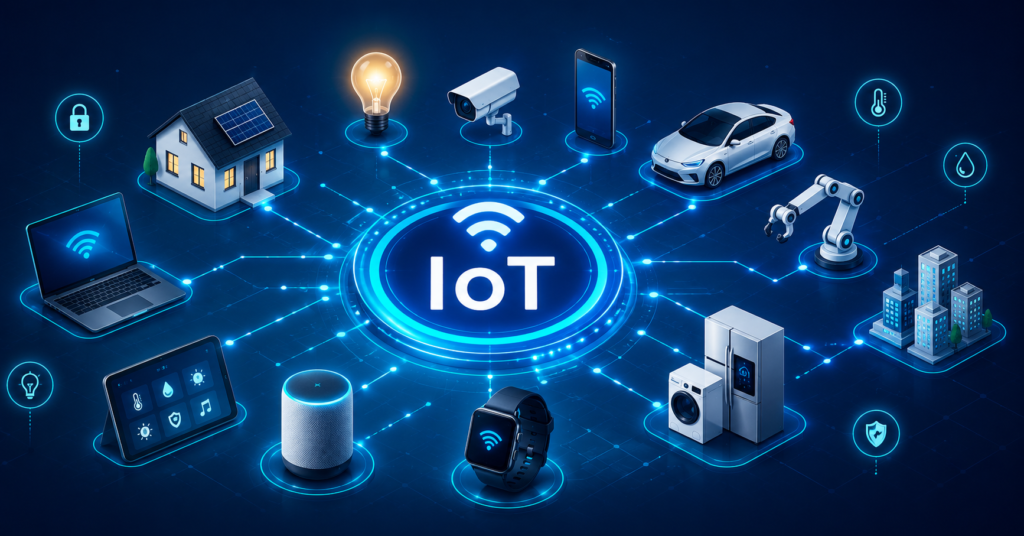
The world around us is becoming smarter every day. From voice-controlled assistants and smart home devices to connected cars and wearable fitness trackers, technology is changing how we live and work. At the heart of these innovations is the Internet of Things (IoT)—a technology that enables everyday devices to connect to the internet and communicate with each other.
In this beginner-friendly guide, you’ll learn what the Internet of Things is, how IoT works, Internet of Things tech, Internet of Things platforms, its benefits, real-world applications, challenges, and why it is considered one of the most transformative technologies of the digital age.
At New Info Technology USA, our goal is to simplify complex technology concepts and help readers stay informed about the latest digital innovations.
What Is the Internet of Things?
The Internet of Things (IoT) is a network of physical devices connected to the internet that can collect, exchange, and process data without requiring constant human interaction.
Unlike traditional electronic devices that only perform manual tasks, IoT devices are equipped with sensors, software, processors, and internet connectivity. These components allow them to communicate with other devices, send information to cloud platforms, analyze data, and even perform automated actions.
Think of IoT as giving everyday objects the ability to “talk” to each other.
For example:
- A smartwatch records your heart rate and sends the information to your smartphone.
- A smart thermostat learns your daily routine and automatically adjusts your home’s temperature.
- Smart security cameras detect unusual movement and immediately notify your phone.
- Connected refrigerators monitor food supplies and remind you when items are running low.
Instead of working independently, these devices work together to create a smarter, more connected experience.
Explain the Internet of Things in Simple Words
To explain the Internet of Things in the simplest way, imagine that ordinary objects suddenly become intelligent.
Normally, devices like fans, lights, washing machines, cars, or medical equipment perform only the tasks that people manually control. However, when these devices are connected to the internet and equipped with sensors, they can collect information, communicate with other devices, and make certain decisions automatically.
For example, consider a smart home:
- Your smart door lock unlocks automatically when you arrive.
- Motion sensors detect movement and switch on the lights.
- Smart speakers play your favorite music with a simple voice command.
- Smart thermostats adjust room temperatures based on weather conditions.
All of these devices are connected through the internet and share information to make daily life easier, safer, and more efficient.
This is exactly what the Internet of Things is all about—connecting physical objects so they can work intelligently together.
How Does the Internet of Things Work?
Although IoT may seem complex, its working process is quite simple. Every IoT system follows a series of connected steps.
1. Data Collection
Everything begins with sensors. Sensors are installed inside IoT devices to collect information from the surrounding environment. Depending on the device, they may measure:
- Temperature
- Humidity
- Motion
- Location
- Pressure
- Heart rate
- Speed
- Air quality
- Light intensity
For example, a smartwatch continuously monitors your heart rate throughout the day.
2. Internet Connectivity
Once the information is collected, it is sent over the internet using communication technologies such as:
- Wi-Fi
- Bluetooth
- 5G
- Cellular networks
- Zigbee
- LoRaWAN
This allows devices to communicate regardless of their physical location.
3. Cloud Storage
The collected data is transferred to cloud servers where it is stored securely. Cloud computing makes it possible to manage millions of connected devices simultaneously while providing access from anywhere in the world.
4. Data Processing
Software applications analyze the incoming data. Modern IoT systems often use Artificial Intelligence (AI) and Machine Learning (ML) to recognize patterns, predict outcomes, and automate decision-making.
For example, a smart irrigation system analyzes weather forecasts and soil moisture before deciding whether watering is necessary.
5. User Interaction
Finally, users access the processed information through mobile apps, websites, dashboards, or voice assistants.
Users can:
- Receive notifications
- Monitor device status
- View reports
- Control devices remotely
- Change settings instantly
Internet of Things Tech
The phrase Internet of Things tech refers to the technologies that make IoT systems function efficiently. Some of the most important IoT technologies include:
Artificial Intelligence (AI)
AI enables devices to learn from collected data and make intelligent decisions automatically.
Cloud Computing
Cloud platforms provide storage, computing power, and remote access for connected devices.
Edge Computing
Instead of sending all information to cloud servers, edge computing processes data closer to the device, reducing delays and improving response times.
Machine Learning
Machine learning algorithms analyze historical data to identify patterns and improve predictions over time.
Sensors
Sensors detect physical conditions such as temperature, pressure, humidity, movement, and light.
Wireless Communication
Technologies like Wi-Fi, Bluetooth, 5G, Zigbee, and LoRaWAN enable devices to exchange information efficiently. Together, these technologies form the foundation of modern IoT ecosystems.
What Is an Internet of Things Platform?
An Internet of Things platform is a software solution that helps organizations connect, monitor, manage, and analyze IoT devices from a centralized system.
Without an IoT platform, managing hundreds or thousands of connected devices would be extremely difficult.
An IoT platform allows businesses to:
- Register new devices
- Monitor device health
- Collect sensor data
- Analyze performance
- Automate workflows
- Update device software remotely
- Secure connected devices
- Generate reports and dashboards
Whether managing smart factories, connected vehicles, healthcare equipment, or smart cities, IoT platforms simplify large-scale device management.
Benefits of the Internet of Things
The Internet of Things provides significant advantages across industries by improving efficiency, reducing costs, enhancing automation, and enabling better decision-making. From smart homes to industrial operations, IoT helps organizations and individuals use connected technology more effectively.
Increased Automation
IoT devices automate repetitive tasks such as controlling lighting, regulating temperature, monitoring machinery, and managing irrigation systems. Automation reduces manual effort while improving speed and accuracy.
Better Decision-Making
Connected devices generate real-time data that helps businesses monitor operations, identify trends, and respond quickly to changing conditions. Accurate information leads to smarter and faster decisions.
Improved Efficiency
By connecting equipment, employees, and business processes, IoT eliminates unnecessary delays and streamlines operations, resulting in higher productivity.
Cost Reduction
Predictive maintenance, energy optimization, and efficient resource management help businesses lower operational expenses and reduce equipment downtime.
Enhanced Safety
IoT sensors can detect hazards such as gas leaks, equipment failures, or unauthorized access, enabling faster responses and improving workplace and home safety.
Challenges of the Internet of Things
Despite its many advantages, IoT also presents several challenges.
- Cybersecurity Risks: Connected devices can become targets for hackers if they are not properly secured.
- Privacy Concerns: IoT systems collect large amounts of personal and business data, making strong privacy protections essential.
- Compatibility Issues: Devices from different manufacturers may not always communicate seamlessly.
- Data Management: Billions of IoT devices generate massive amounts of data that require efficient storage, processing, and analysis.
Addressing these challenges is essential for building secure and reliable IoT ecosystems.
The Future of the Internet of Things
The future of IoT is expected to be even more connected and intelligent. Advancements in Artificial Intelligence, 5G networks, edge computing, and cloud technologies will enable faster communication, smarter automation, and more reliable data processing.
Emerging innovations such as smart cities, autonomous vehicles, connected healthcare systems, intelligent manufacturing, and precision agriculture will continue to expand the role of IoT in everyday life. As billions of devices become interconnected, IoT will play a central role in digital transformation across industries.
Conclusion
The Internet of Things is transforming the way people live, work, and interact with technology. By enabling everyday devices to connect, communicate, and share data, IoT improves efficiency, enhances convenience, and supports smarter decision-making in homes, businesses, healthcare, manufacturing, agriculture, and many other sectors.
Whether you’re learning what is Internet of Things, looking to explain the Internet of Things, exploring Internet of Things tech, or understanding the role of an Internet of Things platform, having a solid understanding of IoT is essential in today’s connected world.
At New Info Technology USA, we believe that understanding emerging technologies empowers individuals and businesses to make informed decisions. As IoT continues to evolve, it will remain one of the key technologies shaping the future of innovation and digital transformation.
Frequently Asked Questions (FAQs)
1. What is the Internet of Things (IoT)?
The Internet of Things (IoT) is a network of physical devices connected to the internet that can collect, share, and exchange data. These devices use sensors, software, and connectivity to communicate with each other and perform tasks automatically, making everyday life and business operations more efficient.
2. How does the Internet of Things work?
The Internet of Things works by using sensors to collect data from devices. This data is sent over the internet to cloud platforms or edge computing systems, where it is processed and analyzed. Based on the results, the devices can take automatic actions or provide real-time information to users through mobile apps or dashboards.
3. What are some examples of Internet of Things devices?
Common examples of IoT devices include:
- Smart thermostats
- Smartwatches and fitness trackers
- Smart TVs
- Smart security cameras
- Smart refrigerators
- Connected cars
- Voice assistants like smart speakers
- Industrial sensors
4. What are the main benefits of the Internet of Things?
The Internet of Things offers many benefits, including:
- Increased automation
- Improved efficiency and productivity
- Better decision-making through real-time data
- Cost savings
- Enhanced security and safety
- Predictive maintenance
- Improved customer experience
- Smarter resource management
5. What is an Internet of Things platform?
An Internet of Things platform is a software solution that helps businesses connect, monitor, manage, and analyze IoT devices from a centralized system. It simplifies device management, data collection, security, and automation across large networks of connected devices.