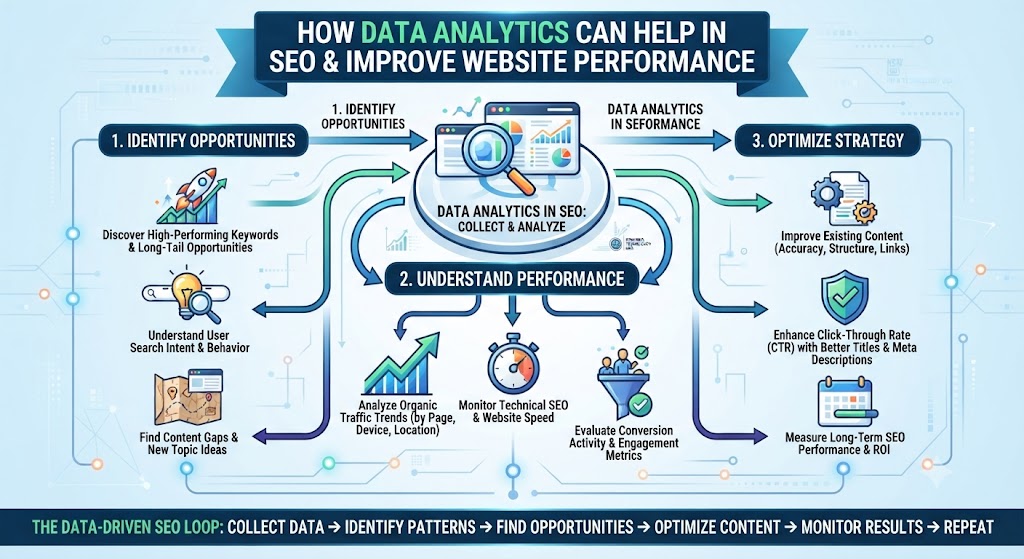
Data analytics has become an important part of modern SEO. Search data can help SEO teams understand how people discover a website, which pages attract visitors, what content performs well, and where improvements may be needed. However, working with data is not always simple.
Using data analytics for SEO can range from simple performance tracking to complex analysis involving large datasets, AI tools, and multiple analytics platforms. The difficulty often depends on the amount of data being analyzed, the quality of the available information, and the technical skills required to interpret it.
For SEO teams, data analytics is increasingly connected with artificial intelligence (AI) and cybersecurity. Understanding these areas can help professionals work with data more effectively while protecting the systems and information involved.
What Is Data Analytics in SEO?
Data analytics in SEO involves collecting, organizing, analyzing, and interpreting information related to a website’s search performance.
SEO professionals can use analytics to understand:
- Which keywords bring visitors to a website
- Which pages receive organic traffic
- How users interact with website content
- Which search queries generate impressions and clicks
- Which pages have strong or weak performance
- How organic traffic changes over time
- Which content opportunities may be worth investigating
The purpose isn’t simply to collect large amounts of information. The goal is to turn that information into useful insights that can support SEO decisions.
How Hard Is Data Analytics?
The difficulty of data analytics depends on the type and amount of data being analyzed. Basic tasks, such as checking organic traffic or identifying a website’s most visited pages, can be relatively easy to learn. More advanced work can require knowledge of statistics, spreadsheets, databases, data visualization, programming, and analytical tools. For SEO teams, complexity can increase when data comes from several different sources.
For example, a team might work with:
- Google Search Console
- Google Analytics
- Keyword research tools
- Backlink databases
- Website performance data
- Conversion information
- CRM data
Each platform can measure information differently, which makes interpretation more challenging.
1. Managing Large Amounts of SEO Data
One of the biggest challenges facing SEO teams is the amount of information available. A large website may have thousands of keywords, hundreds or thousands of pages, multiple traffic sources, and years of historical data. Looking at every individual data point isn’t practical. Instead, SEO teams need to identify the metrics that are most relevant to their goals.
Important measurements can include:
- Organic clicks
- Search impressions
- Click-through rate
- Search positions
- Organic sessions
- Landing-page performance
- Conversion rate
- Engagement metrics
The challenge is finding meaningful patterns without becoming overwhelmed by the volume of information.
2. Maintaining Data Quality
Data analytics depends heavily on the quality of the information being analyzed. Incorrect tracking, missing data, duplicate URLs, improperly configured analytics, or inconsistent measurement can lead to misleading conclusions. For example, if conversion tracking isn’t configured correctly, an SEO team might believe that a particular page generates very few leads even though users are actually converting. Before making major SEO decisions, teams should therefore check whether their tracking systems are working correctly. Good data analysis begins with reliable data.
3. Understanding Search Intent
SEO analytics provides numbers, but numbers alone don’t always explain why people behave in a particular way. Search intent is an important part of interpreting SEO data.
For example, someone searching for:
what is artificial intelligence
is probably looking for educational information. Someone searching for:
AI software for business
may have a different purpose and could be researching available solutions. Both searches may contain AI-related keywords, but their underlying intentions are different. SEO teams need to combine quantitative data with an understanding of search intent to create useful content strategies.
4. Using AI in SEO Data Analytics
Artificial intelligence is increasingly being used to process and analyze large datasets.
AI tools can assist SEO teams with tasks such as:
- Grouping related keywords
- Identifying patterns
- Summarizing datasets
- Finding content gaps
- Classifying search queries
- Analyzing large amounts of text
- Automating repetitive tasks
For example, instead of manually reviewing thousands of keywords, an AI system may help organize them into topical groups, AI-generated analysis should not automatically be treated as correct.
AI tools can misunderstand context, work with incomplete information, or produce conclusions that need further verification. Human judgment remains important when interpreting data and deciding what actions to take.
5. Cybersecurity Risks in Data Analytics
Cybersecurity is another important consideration for SEO teams. SEO professionals often have access to websites, analytics platforms, search tools, APIs, content management systems, and other digital accounts. If these systems aren’t properly protected, unauthorized users could potentially gain access to sensitive information or make unwanted changes.
Common security concerns include:
- Compromised passwords
- Unauthorized account access
- Stolen API credentials
- Phishing attacks
- Malicious website changes
- Tracking-code manipulation
- Data exposure
SEO teams can reduce unnecessary risks by using strong passwords, multi-factor authentication, appropriate user permissions, secure API credentials, and regular access reviews.
6. Combining Data From Multiple Platforms
Another challenge is combining information from different tools.
Consider an SEO team using:
Google Search Console + Google Analytics + an SEO platform + CRM data
Each system may use different definitions and measurement methods. For example, Search Console focuses on search results activity, while an analytics platform can provide information about website sessions and user behavior. These numbers shouldn’t always be treated as identical measurements. SEO professionals need to understand what each platform measures before combining or comparing the data.
7. Turning Data Into Useful SEO Decisions
Collecting data is only one part of analytics. The more difficult step can be determining what the data means and what action should follow.
Imagine a page has:
- High search impressions
- A relatively low click-through rate
- Visibility for relevant keywords
The data may encourage an SEO team to investigate the page title, description, search intent, or how the result is presented in search. Another page may receive substantial organic traffic but generate few conversions. That could lead the team to examine the content, user journey, page purpose, or conversion process. Analytics doesn’t automatically provide the solution. It provides evidence that can guide further investigation.
8. Keeping Up With Changes in AI and SEO
Technology changes quickly. Search engines, analytics platforms, AI tools, and SEO software regularly introduce new features and measurement methods.
This creates another challenge for SEO professionals: keeping their knowledge current. A technique that worked with one analytics system may need to be adjusted when the platform changes how information is collected or presented.
Professionals therefore need to continue learning about:
- SEO
- Data analytics
- AI
- Website technology
- Data privacy
- Cybersecurity
This broader knowledge can make it easier to understand how different technologies affect SEO work.
How Can SEO Teams Make Data Analytics Easier?
Data analytics doesn’t have to be unnecessarily complicated.
SEO teams can make the process more manageable by following a structured approach.
Define the Objective
Start by identifying what you want to understand.
For example:
- Why has organic traffic changed?
- Which pages attract the most search traffic?
- Which keywords have growth opportunities?
- Why is organic CTR low?
- Which pages generate conversions?
A clear objective makes it easier to determine which data is actually relevant.
Focus on Relevant Metrics
Don’t analyze every metric simply because it is available.
Choose measurements that are connected to the specific SEO objective.
Check Data Accuracy
Before making important decisions, verify that analytics and tracking systems are correctly configured.
Use AI as an Assistant
AI can help process large amounts of information and identify patterns, but important conclusions should be reviewed by people who understand the context.
Protect Your Data
Use appropriate security controls for analytics accounts and website systems. Limit access according to users’ responsibilities and review permissions regularly.
Analyze Trends Over Time
A single data point may not provide enough context. Comparing performance over weeks, months, or longer periods can help identify meaningful trends.
The Connection Between SEO, AI, and Cybersecurity
Modern SEO increasingly intersects with other areas of technology. Data analytics helps SEO teams understand website and search performance. AI can assist with processing large datasets and identifying patterns. Cybersecurity helps protect the accounts, websites, and information used during these activities.
These areas can work together. For example, an SEO team might use analytics data to identify a decline in organic traffic, use AI to organize and analyze large datasets, and rely on cybersecurity controls to protect access to the systems containing that information. Understanding these connections can help SEO professionals approach data more efficiently and responsibly.
Conclusion
Data analytics can be relatively simple when used for basic reporting, but it becomes more challenging when SEO teams work with large datasets, multiple platforms, AI systems, and cybersecurity requirements.
The main challenge isn’t simply collecting more information. It is determining which data matters, checking its accuracy, understanding its context, and turning it into useful insights. AI can make large-scale analysis faster and more efficient, while cybersecurity remains important for protecting the systems and information involved.
For SEO professionals, developing a working understanding of data analytics, AI, and cybersecurity can provide a broader view of how technology is shaping modern search optimization.
New Info Technology USA focuses on informational technology content that explores topics such as AI, software, cybersecurity, digital marketing, and other technologies and their impact on everyday digital life.
Frequently Asked Questions
1. How hard is data analytics for beginners?
Basic data analytics can be learned gradually using spreadsheets, dashboards, and analytics platforms. Advanced analytics involving statistics, programming, databases, or machine learning generally requires more technical knowledge and practice.
2. Why is data analytics important for SEO?
Data analytics helps SEO teams understand search performance, identify trends, evaluate content, and make decisions using measurable information.
3. How does AI help with SEO data analytics?
AI can help organize keywords, identify patterns, summarize datasets, analyze content, and automate repetitive analytical tasks. Human review is still important for interpreting the results.
4. Why is cybersecurity important for SEO teams?
SEO teams may have access to websites, analytics accounts, APIs, and other digital systems. Security practices can help reduce the risk of unauthorized access, data exposure, and malicious changes.
5. What skills are useful for SEO data analytics?
Useful skills include SEO fundamentals, data interpretation, spreadsheets, analytics platforms, basic statistics, data visualization, critical thinking, and an understanding of AI and cybersecurity.
6. Can AI replace SEO data analysts?
AI can automate or assist with many analytical tasks, but SEO analysis often requires context, critical thinking, business understanding, and human judgment. AI is therefore better viewed as a tool that can support analytical work rather than automatically replacing every aspect of it.