Machine learning has changed how computers analyze information, recognize patterns, and make predictions. But traditional machine learning systems often depend on human intervention to review results, update models, and improve performance. A more continuous approach is closed-loop machine learning, where the system uses feedback from its own results to improve future decisions.
For anyone researching what is closed loop machine learning, the basic idea is simple: a machine learning system makes a prediction or decision, receives feedback about the result, and uses that feedback to improve its future performance. This creates a continuous cycle of learning and adjustment.
In this article from New Info Technology USA, we will explain what closed-loop machine learning means, how it works, its main components, benefits, applications, and challenges.
What Is Closed Loop Machine Learning?
What is closed loop machine learning? It is a machine learning approach in which a model continuously receives feedback from its predictions or actions and uses that information to improve future outcomes.
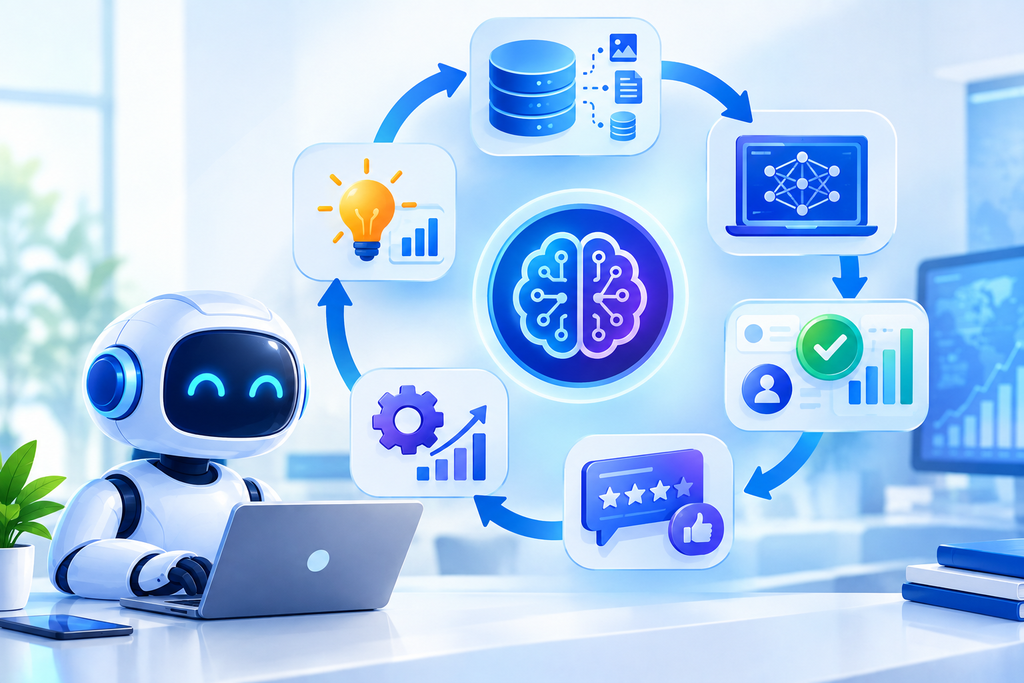
A typical closed-loop system follows a cycle:
Data → Model → Prediction or Action → Feedback → Model Improvement → New Prediction
Instead of training a model once and leaving it unchanged, a closed-loop machine learning system can continuously learn from new information and feedback.
For example, imagine a recommendation system that suggests movies to users. If a user watches a recommended movie, skips it, rates it, or chooses something else, that behavior provides feedback. The system can analyze this information and improve future recommendations.
How Does Closed-Loop Machine Learning Work?
Closed-loop machine learning generally works through several connected stages.
1. Data Collection
The process starts with collecting data from different sources. This could include user interactions, sensors, business transactions, application activity, or other digital information.
The quality and relevance of the data are important because the machine learning model depends on this information to identify patterns.
2. Model Makes a Prediction
The collected data is processed by a machine learning model. Based on patterns learned during training, the model produces a prediction, recommendation, classification, or action.
For example, a cybersecurity system might analyze network activity and predict whether unusual behavior could represent a potential security threat.
3. The System Receives Feedback
After the model makes its prediction or takes an action, the system can receive feedback.
Feedback may come from:
- User behavior
- Human reviews
- New data
- Sensor readings
- Business outcomes
- Correct or incorrect predictions
- System performance measurements
This feedback is an important part of the closed-loop process.
4. Feedback Is Analyzed
The system evaluates the feedback to determine how well the previous prediction or action performed.
If a recommendation was useful, that result provides positive information. If a prediction was incorrect, the system can use the error to understand what needs improvement.
5. The Model Is Updated
The information gained from feedback can then be used to improve the model.
Depending on the system, this may involve retraining the model, adjusting parameters, updating data, or changing how predictions are generated.
6. The Cycle Repeats
Once the model has been improved, it continues making new predictions or decisions. New outcomes generate additional feedback, which can be used for further improvement.
This creates a continuous learning cycle.
A Simple Example of Closed-Loop Machine Learning
Consider an online shopping recommendation system. A customer searches for running shoes. The machine learning model analyzes the customer’s previous activity and recommends several products.
The customer clicks on one recommendation but ignores the others. Later, the customer purchases a different type of shoe. These actions provide feedback to the system. The model can use this information to better understand the customer’s interests. The next time the customer searches for sports products, the system may provide more relevant recommendations.
This illustrates the basic principle of closed-loop machine learning:
Prediction → User Action → Feedback → Learning → Improved Prediction
Key Components of a Closed-Loop Machine Learning System
Several components work together to create a closed learning cycle.
Machine Learning Model
The model analyzes data and produces predictions or decisions.
Data Pipeline
A data pipeline collects, processes, and delivers new information to the machine learning system.
Feedback Mechanism
The feedback mechanism captures information about how predictions or actions performed.
Monitoring System
Monitoring helps track model accuracy, performance, errors, and changes in incoming data.
Model Updating Process
The model updating process uses new information and feedback to improve future predictions.
Human Oversight
Although automation is an important part of closed-loop systems, humans may still be involved in reviewing unusual outcomes, setting rules, or validating important decisions.
What Is the Difference Between Open-Loop and Closed-Loop Machine Learning?
The main difference is how feedback is handled.
In an open-loop system, the model generally produces an output without automatically using the outcome to improve the next cycle.
In a closed-loop system, the output is evaluated through feedback, and that information can influence future predictions or actions.
For example:
- Open Loop: Input → Model → Output
- Closed Loop: Input → Model → Output → Feedback → Model Improvement → New Output
The closed-loop approach is particularly useful when the environment changes frequently and the model needs to adapt to new information.
Benefits of Closed-Loop Machine Learning
Closed-loop machine learning can provide several advantages.
Continuous Improvement
Models can improve as they receive new information and feedback.
Better Adaptability
A closed-loop system can respond to changing patterns instead of relying entirely on historical training data.
Improved Predictions
When useful feedback is available, models can become more accurate over time.
Faster Detection of Errors
Feedback can help identify incorrect predictions or unexpected behavior earlier.
Greater Automation
Automated feedback and updating processes can reduce the need for manual model adjustments.
Applications of Closed-Loop Machine Learning
Closed-loop machine learning can be used in many areas of technology.
Recommendation Systems
Streaming platforms, shopping websites, and content applications can use user interactions as feedback to improve recommendations.
Cybersecurity
Security systems can analyze network activity, identify unusual behavior, and use new information to improve future threat detection.
Robotics
Robots can use information from sensors and their environment to adjust actions and improve performance.
Autonomous Systems
Some autonomous technologies use feedback from their environment to continuously adjust their behavior.
Healthcare Technology
Machine learning systems can potentially use new information and outcomes to improve predictions and support certain analytical tasks, although high-stakes healthcare applications require careful validation and human oversight.
Industrial Automation
Factories can use sensors and machine learning to monitor equipment, identify unusual conditions, and optimize operations.
Challenges of Closed-Loop Machine Learning
Although the approach offers important benefits, it also introduces challenges.
Poor Feedback Can Create Poor Learning
If feedback is inaccurate or biased, the model may learn incorrect patterns.
Data Quality Matters
New data must be reliable and relevant. Low-quality data can negatively affect model performance.
Model Drift
Real-world patterns can change over time. A model that performed well previously may become less effective when conditions change.
Feedback Loops Can Reinforce Bias
A system may repeatedly learn from its own previous decisions. If those decisions contain bias, the feedback loop could strengthen that bias.
Monitoring Is Necessary
Continuous learning systems require monitoring to identify errors, unexpected behavior, and performance changes.
Human Oversight May Still Be Required
Not every decision should be completely automated. In sensitive or high-impact situations, human review can remain important.
Why Is Closed-Loop Machine Learning Important?
Closed-loop machine learning is important because real-world environments are constantly changing.
A model trained on historical data may not always perform well when user behavior, market conditions, technology, or other circumstances change.
A closed-loop approach provides a way to incorporate new information into the learning process. Instead of treating machine learning as a one-time training activity, it treats learning as an ongoing cycle.
This concept is becoming increasingly relevant as AI systems are used in recommendation engines, robotics, cybersecurity, automation, and other technology applications.
Conclusion
Understanding what is closed loop machine learning starts with understanding the role of feedback. A closed-loop machine learning system makes predictions or decisions, observes the results, collects feedback, and uses that information to improve future performance.
The process can be represented simply as data, prediction, feedback, learning, and improvement. This continuous cycle can help machine learning systems adapt to changing conditions and become more useful over time.
However, closed-loop machine learning is not automatically perfect. Data quality, feedback accuracy, model drift, bias, monitoring, and human oversight all play important roles. When these factors are carefully managed, closed-loop approaches can support more adaptive and responsive machine learning systems.
Frequently Asked Questions
1. What is closed-loop machine learning?
Closed-loop machine learning is a system where a model makes predictions or decisions, receives feedback about the results, and uses that feedback to improve future performance.
2. How does closed-loop machine learning work?
It typically works through a repeating process of collecting data, making a prediction or taking an action, receiving feedback, analyzing the outcome, updating the model, and generating new predictions.
3. What is an example of closed-loop machine learning?
A recommendation system is a common example. User clicks, purchases, ratings, and other interactions can provide feedback that helps the system improve future recommendations.
4. What is the difference between open-loop and closed-loop machine learning?
Open-loop systems generally produce outputs without using the outcomes as an automatic feedback mechanism. Closed-loop systems use feedback from outcomes to influence future predictions or model improvements.
5. Can closed-loop machine learning improve model accuracy?
It can improve performance when the feedback and data are accurate, relevant, and properly incorporated into the learning process. However, continuous feedback does not guarantee better accuracy.